A Language I Had Forgotten to Think In
On that particular June day, Berlin was boiling. I came directly from school, racing across the city through traffic I had almost forgotten since moving outside Berlin.
Walking towards the entrance, I caught fragments of conversations between groups of students. Quickly shared timetables, sharp arguments about stuff they study, the blissfully practical concerns of people for whom the university was still a place of possibility. There was a confidence about them that made my own shrink in a few heartbeats, and perhaps an ingrained idealism, although idealism may no longer be a word their generation would chew as gleefully as mine once did. I felt jealous of them. For a moment, entering the building felt strangely like an examination: Is what I have brought here in any way relevant to people studying now, in this place, at this time?
Upstairs, the room was comfortably cool and bright. There was plenty of finger food and a warm welcome in Romanian. Only later did I learn that the person welcoming us was Anamaria Radu.
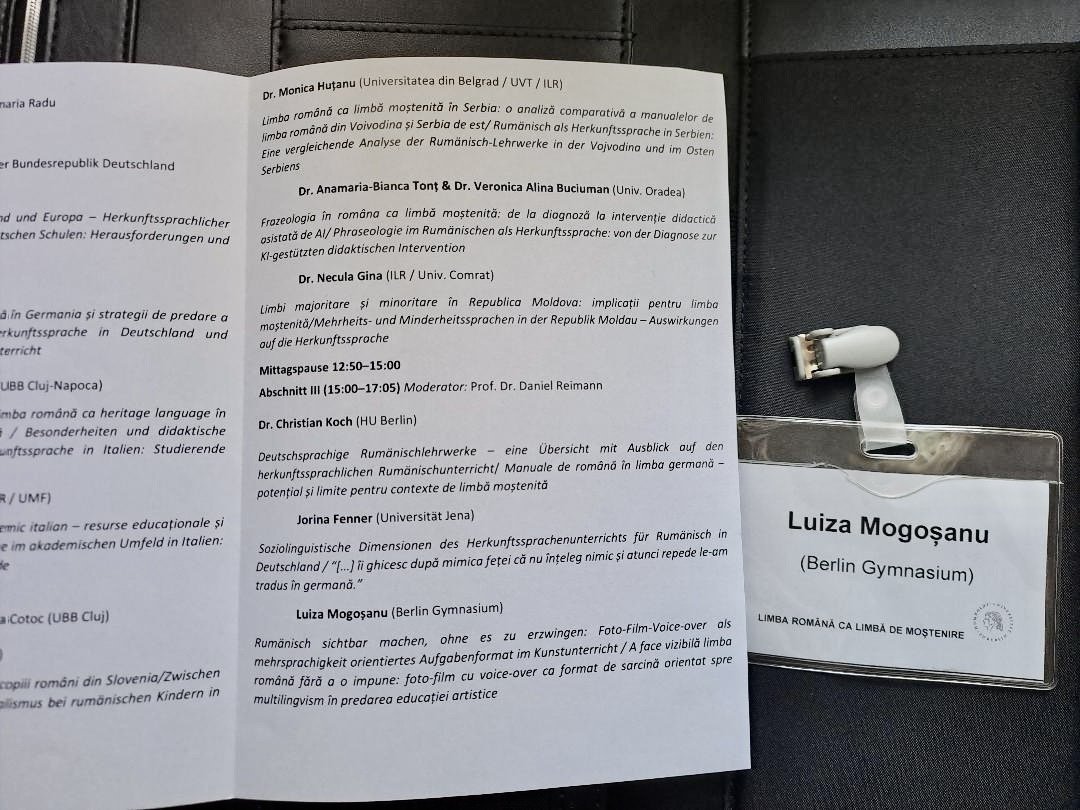
Over the course of the afternoon, the conference, Rumänisch als Herkunftssprache in Deutschland / Limba română ca limbă moștenită, revealed forms of Romanian existence I had rarely thought about during nineteen years of living outside Romania.
Christian Koch spoke about German-language textbooks for Romanian and their possibilities and limitations for heritage-language teaching. Jorina Fenner's contribution opened another landscape: Romanian as a language that exists within German schools not simply because individual children happen to speak it at home, but through forms of heritage-language education shaped by communities, institutions and the sociolinguistic realities of their pupils. Lasse Birger Bohn brought us closer to the children themselves, to the movements between languages that appear in primary-school classrooms and to children's own perspectives on living between home and school. These were not variations on one question. They revealed how many different things a language can be once it crosses borders.
I had come to speak about something rather specific: two art-education formats in which multilingual pupils had been invited to use their languages, and the puzzlingly different results. In one, Romanian became part of the work. In another, although explicitly available, it did not. My question was about task design: what makes a language not merely permitted but actually usable?
Then Alexandra Cotoc and Anamaria Radu presented their study of Romanian as a heritage language among students in Germany: its use, attitudes towards it, and its relationship to identity. As I listened, their questions began opening drawers I thought I had temporarily closed.
I thought about families I know whose children do not speak Romanian, sometimes from their parents' desire to make integration into German life easier. I thought about my own son, and the accident of good fortune by which Romanian became one of his languages, substantially through his grandmother.
I had often thought about what is transmitted with a language, and about what happens when transmission stops. But somehow I had never asked these questions of my own language. As if my troubled relationship with a certain topography had drawn an epistemic boundary through my mind.
But there was something else.
We were naturally discussing these things in Romanian. Without being in Romania. Without asking for permission.
I left Romania nineteen years ago. Since then, Romanian has remained only a small part of my everyday life: short, practical exchanges with my mother; sometimes, briefly, with a friend. But not part of my academic life. I had not participated in an academic environment in Romania since leaving. French, then German and English had become the languages in which I teach, research, present, argue, formulate concepts.
And suddenly I was sitting at Humboldt University in Berlin, speaking about questions that matter to my work, in Romanian.
Nothing spectacular happened. No lost identity snapped theatrically back into place. The language had never been lost.
What I had forgotten was what it felt like to think professionally inside it.